
From Layoff to 7 Continents Week 10: What I’m Reading Before South America + Antarctica
From Layoff to 7 Continents Week 10: What I’m Reading Before South America + Antarctica
Preparing for a major trip usually brings to mind flights, hotels, packing lists, clothing, and transportation.
As I get closer to visiting my final two continents—South America and Antarctica—there is another kind of preparation that matters just as much:

Reading South American and Antarctica: Understanding the Places I’m About to Experience
For Week 10 of my From Layoff to 7 Continents journey, I spent the day at the library researching my upcoming trip.
Recently, my son and I went to our local library.
What started as a simple library visit turned into a busy and enlightening day of reading.
We browsed the shelves, checked out several physical books, and discovered my library card also gives me access to digital books.
Instead of only asking, “What should I pack?” I’m asking different questions:
What should I understand about my destination's culture before I arrive?
What history and culture have shaped these destinations?
What wildlife might I encounter?
And how can learning more before departure make the experience more meaningful?

Reading South American and Antarctica: Preparing for Travel Beyond the Packing List
I’ve already been preparing for this trip in practical ways.
I purchased my expedition jacket.
I developed an exercise plan to help prepare for trekking through snow.
I’ve been thinking about equipment, logistics, and what I’ll need for Antarctica.
But preparation doesn’t have to stop there.
I also want to prepare my mind.
Before walking through Buenos Aires, exploring Montevideo, traveling to Ushuaia, and eventually reaching Antarctica, I want to a better understanding about where I’m going.
That desire led me to the library.
Reading South American and Antarctica: What I Found at the Library
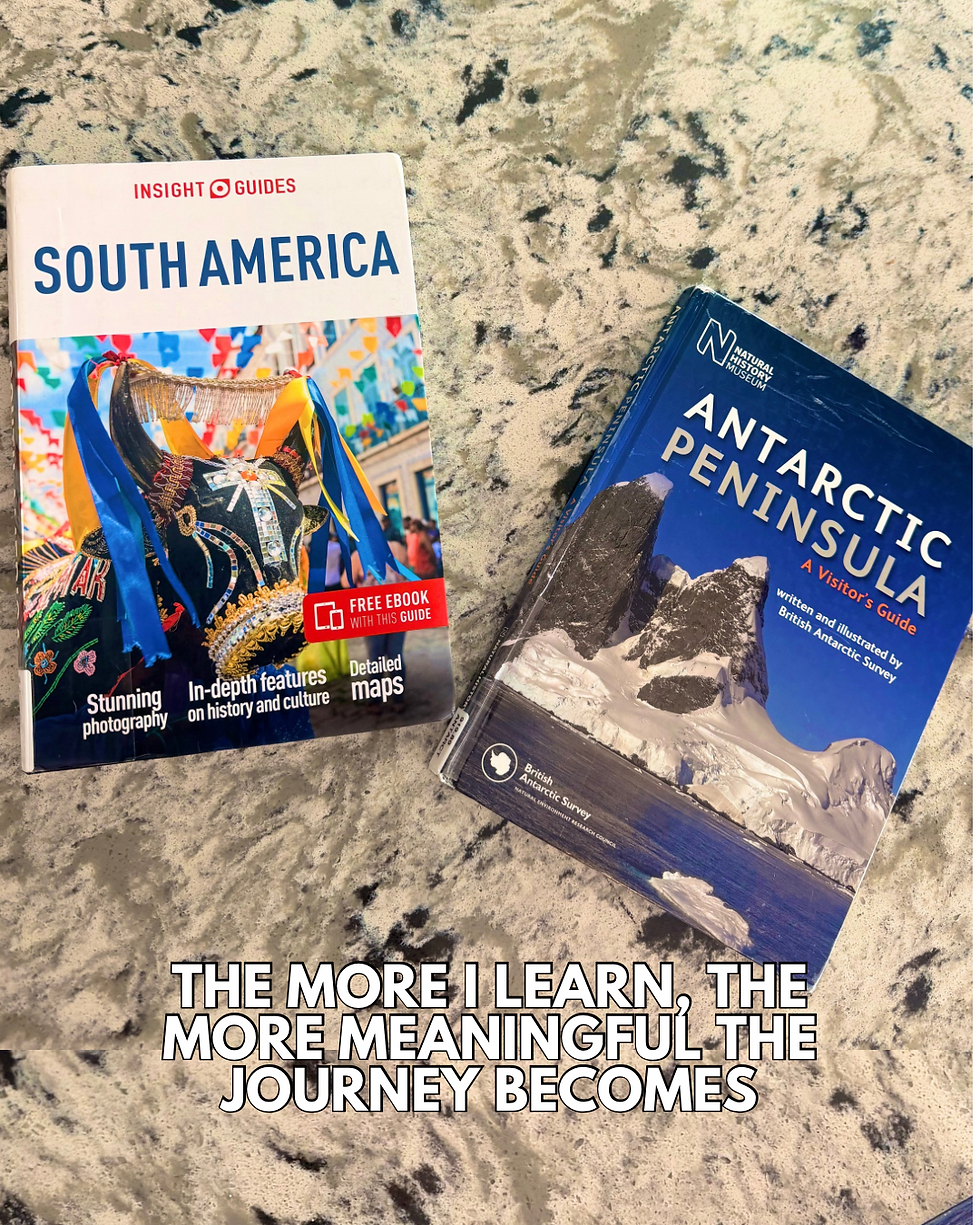
I checked out two physical books:
and
Both gave me different perspectives on the journey ahead.
The Antarctic guide allows me to focus specifically on the environment and visitor experience of the Antarctic Peninsula.
The South America guide was particularly useful because it covered the three South American destinations on my upcoming itinerary:
That meant I could research the places I’ll actually be visiting rather than only reading about South America in general.

Reading South American and Antarctica: Learning More About Buenos Aires
Buenos Aires will be one of my major stops in Argentina, so I wanted to learn more than simply which attractions to visit.
I’ve been reading about the city’s culture, history, neighborhoods, food, architecture, and experiences that help define Buenos Aires.
I also checked out the digital guide Fodor’s Buenos Aires to supplement what I found in the South America book.
Before arriving, I want some context for what I’m seeing.
There is a difference between standing in front of a landmark and understanding something about the city around it.
Reading South American and Antarctica: Looking Beyond Buenos Aires With Lonely Planet Argentina
I also checked out Lonely Planet Argentina digitally.
This gives me a broader perspective on Argentina beyond Buenos Aires.
Argentina is an enormous and geographically diverse country, and traveling between Buenos Aires and Ushuaia will expose me to two very different parts of it.
I want to understand that contrast.
The more I read, the more I realize that this trip isn’t simply a sequence of stops.
Each destination is part of a larger geographic and cultural story.

Reading South American and Antarctica: Researching Ushuaia and Tierra del Fuego
Ushuaia has a very different role in this journey.
Located far south in Argentina, Ushuaia, also referred to as "El Fin del Mundo," (The End of the World) will be part of my transition from South America toward Antarctica.
I’ve been reading about the geography of Tierra del Fuego, the landscapes surrounding Ushuaia, and what makes the destination so closely associated with Antarctic travel.
I’m especially interested in experiencing Ushuaia as more than simply a departure point.
It is part of the journey itself.
Before boarding my Antarctica expedition, I want to understand the place where that final chapter begins.
Reading South American and Antarctica: Learning About Montevideo, Uruguay
The South America guide also gave me an opportunity to research Uruguay's capital, Montevideo, Uruguay.
I’ve been learning more about the city’s history, culture, architecture, neighborhoods, and local experiences.
Visiting Uruguay will allow me to experience another country and another perspective on South American life during this trip.
That is part of what makes this final journey particularly meaningful.
South America won’t be represented by just one city or one country for me.
I’ll have the opportunity to experience destinations in both Argentina and Uruguay before heading toward Antarctica.

Reading South American and Antarctica: Understanding the Antarctic Peninsula
One of my physical library finds was Antarctic Peninsula: A Visitor’s Guide, written and illustrated by the British Antarctic Survey.
The Antarctic Peninsula is central to my upcoming expedition, so I wanted to learn more about the place itself before seeing it.
I’m reading about topics such as:
Geography
The natural environment
Wildlife
Visitor experiences
Conservation
The characteristics that make the Antarctic Peninsula unique
Antarctica is often represented through spectacular images of ice, wildlife, and enormous landscapes.
Those images are part of what makes the destination so compelling.
But I want to understand more than what can be captured in a photograph.

Reading South American and Antarctica: Learning About Antarctic Wildlife
My digital library gave me access to another resource: Tony Soper’s Antarctica: A Guide to the Wildlife.
Wildlife is one of the aspects of Antarctica I’m most excited to learn about.
I’ve been reading about Antarctic animals and ecosystems so that if I encounter wildlife during the expedition, I’ll have more context for what I’m seeing.
My research includes:
Penguins
Seals
Whales
Seabirds
Antarctic ecosystems
Of course, wildlife sightings can never be guaranteed.
One thing that's important with Antarctic cruises, compared to other cruises that may be taken in other parts of the world, is flexibility.
What I actually see will depend on the expedition route, season, weather, and conditions.
But learning beforehand can help turn a wildlife sighting into something more meaningful than simply taking a photograph.
Reading South American and Antarctica: Reading About Antarctic Exploration
I also checked out legendary book South: The Endurance Expedition by Ernest Shackleton.
Shackleton, an Irish man who led several Antarctic expeditions, is a legend in the history of Antarctica.
Shackleton's goal was to reach the South Pole.
Leading multiple expeditions to Antarctica, his final trip aboard his ship Endurance, turned into one of survival, battling against nature's forces.
His ship was sunk.
Ice, freezing water, winds, snow.
Him and his men were on survival mode.
With all this adversity, Shackleton and ALL of his men survived.
Learning about Antarctic exploration adds a completely different dimension to my preparation.
Today, explorers can reach Antarctica in a safer and more comfortable way aboard organized expedition ships and planes with modern navigation, equipment, communication, and safety systems.
Earlier explorers entered an entirely different world.
Reading about that history gives me a deeper appreciation and respect for how remote Antarctica is and how extraordinary it is that I’ll soon have the opportunity to experience the world's largest desert it myself.
I’m not studying exploration history because I want to recreate those journeys.
I’m reading it because understanding what came before can change the way we experience a place today.

Reading South American and Antarctica: Five Things I’m Learning Before South America + Antarctica
After spending the day reading, my research naturally fell into five areas:
1. Buenos Aires, Argentina: Culture, history, neighborhoods, food, architecture, and city life.
2. Ushuaia and Tierra del Fuego: Southern Argentina, geography, landscapes, and Ushuaia’s relationship to Antarctic travel.
3. Montevideo, Uruguay: Culture, history, architecture, neighborhoods, and another perspective on South America.
4. The Antarctic Peninsula and wildlife: Geography, environment, ecosystems, conservation, and wildlife I may encounter.
5. Antarctic exploration history: Understanding the experiences of earlier explorers and how dramatically Antarctic travel has changed.
My Library Card Became a Travel-Planning Tool
One of my favorite discoveries from this research day wasn’t actually a destination.
It was realizing how much information I could access through my library card.
I left the library with two physical books, but I was also able to check out digital books about Antarctica, Buenos Aires, Argentina, and Antarctic exploration.
A library card may not be the first thing people think about when planning an international trip, but it can be an incredibly useful travel resource.
For me, one visit turned into an entire day of research.
And the reading isn’t finished yet.
The More I Learn, the More Meaningful the Journey Becomes
This research has reinforced something important for me:
Travel preparation isn’t only physical or logistical. It can also be educational.
I know reading a handful of books won’t make me an expert on Argentina, Uruguay, or Antarctica.
That isn’t my goal.
My goal is to arrive more informed.
More curious.
More observant.
And more prepared to appreciate what I’m experiencing.
When I walk through Buenos Aires, I want to recognize some of the history and culture I’ve been reading about.
When I arrive in Montevideo, I want to understand more about the country and city I’m entering.
When I reach Ushuaia, I want to appreciate its significance beyond simply being where my Antarctic expedition begins.
And when I finally see Antarctica, I want to understand more about the wildlife, environment, geography, and history surrounding me.
The Final Two Continents Are Getting Closer
I’ve now visited five continents.
South America will become number six.
Antarctica will become number seven.
As I get closer to completing this goal, I’m realizing that I don’t want to rush toward the finish line just to say I reached it.
I want to experience this final chapter intentionally.
I want to learn before I arrive.
I want to observe while I’m there.
And I want to return having gained something beyond photographs and passport stamps.
That is part of what Travel As Transformation means to me.
Sometimes the journey begins with a plane ticket.
Sometimes it begins with a dream.
And sometimes it begins between the shelves of a library.
I don’t just want to arrive. I want to understand where I’m going.
South America and Antarctica—the final two are getting closer.

Comments